Arkansas River Delta Blues Trail Honoree
Queen Sylvia Burton
Pioneering Blues Bassist and Vocalist
One of Chicago Blues' Only Female Bass Players
Born and Raised in Wabbaseka, Arkansas
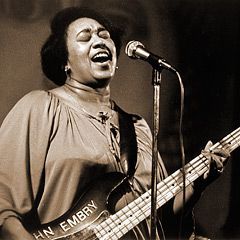
An artist who carried the sound of the Arkansas Delta into the heart of Chicago blues, breaking ground as one of the only women to lead a band from behind the bass.
Sylvia Lee Burton | Queen Sylvia
Sylvia Lee Burton was born on June 14, 1941, in Wabbaseka, Arkansas, a small Delta community just outside Pine Bluff. As a girl she taught herself piano, encouraged by a grandmother who was devoted to gospel music and had little patience for anything else. Burton sang in her church choir and later joined The Southern Echoes, a gospel group, carrying that grounding in gospel vocal tradition with her for the rest of her career, even after the music around her changed.
At 19, she left Arkansas for Memphis, hoping to build a career as a singer. It didn't happen the way she planned. She married, started a family, and set performing aside. When that marriage ended in the early 1960s, she relocated to Chicago and began working with the clubs on the South Side, the same circuit that shaped so much of postwar blues.
In Chicago, Burton met guitarist Johnny Embry. They married, and at her request, he taught her to play electric bass, an instrument almost no woman in Chicago blues played at the time. She has been documented by blues historians and record labels alike as one of only a handful of professional-caliber female instrumentalists on the scene, and the only one playing bass. She joined guitarist Lefty Dizz and his band Shock Treatment, holding down the Blue Monday house band slot at the legendary Checkerboard Lounge for more than three years. Her voice, rooted in gospel but shaped by years in blues clubs, became one of the most requested parts of the show.
At 39, with her children grown, Burton stepped out from behind other bandleaders and recorded her own material for Alligator Records' Living Chicago Blues series in 1980, then began fronting her own band across Chicago's South and North Side club circuits. She appeared at Willie Dixon's Delta Blues Festival, performing alongside Sam Myers, Honeyboy Edwards, and Robert Jr. Lockwood, whose work was later captured in the documentary film Mississippi Delta Blues.
Her reputation grew internationally through a touring partnership with West Side guitarist Jimmy "Fast Fingers" Dawkins. Together they toured Europe in 1982 and 1983 as part of the American Blues Festival, sharing stages and television appearances with Jimmy Rogers, Louisiana Red, and Carey Bell. In 1983, she recorded her solo album, Midnight Baby, released under the name Blues Queen Sylvia, with Dawkins returning the favor by backing her in the studio. She continued touring into the mid-1980s, including a 1986 world tour with The Mississippi All-Stars, again sharing stages with harp player Sam Myers.
Burton's health declined in the late 1980s, and she died of cancer in Chicago on February 28, 1992, at 50 years old, without ever receiving the wider recognition her playing deserved.
For the Arkansas River Delta Blues Trail, Queen Sylvia represents a piece of blues history too often left out of the story of a woman forging her own path, paving the way for others to follow. She worked against the odds of the industry and as a female leader in areas others have not, proving she belonged among her Blues peers. Her path from a Wabbaseka gospel choir to the Checkerboard Lounge to European festival stages is a Delta story for Arkansas to be proud of and continue to be told for generations to come.
Quick Facts:
- Birth name: Sylvia Lee Burton
- Stage name: Queen Sylvia
- Born: June 14, 1941, in Wabbaseka, Arkansas
- Died: February 28, 1992, in Chicago, Illinois
- Genres: Blues, gospel, soul
- Instruments: Vocals, electric bass
- Notable: One of the only female electric bass players in Chicago blues history
- Recordings: Alligator Records' Living Chicago Blues series (1980); solo album Midnight Baby (1983), featuring Jimmy Dawkins
- Toured Europe with the American Blues Festival (1982–83) and The Mississippi All-Stars (1986)
A Curated Collection
Experience the Story of Queen Sylvia Burton
MONTAGE COMING SOON! An immersive short-film experience showcasing Burton's captivating sound that engaged audiences of all cultures.
Experience the Music of Queen Sylvia Burton
Listen to blues pioneer Queen Sylvia Burton, discover your favorites, and experience the talent Arkansas helped shape in the blues as we know it and in the music industry.
Help Us Honor Arkansas Legends
Your support funds the research, marker fabrication, and community events that bring these stories home. The Arkansas River Delta Blues Trail connects communities from Scott to Little Rock and Pine Bluff, activating new tourism, education, and local economic development.
Subscribe To Trail News
Copyright © 2026 Arkansas River Delta Blues Trail - All Rights Reserved.
An Arkansas Originals Preservation & Community Development Project.

Sign Up
Keep up with our events and news releases as the Arkansas River Delta Blues Trail becomes a reality and catalyst for the state's first regional heritage music tourism network.
This website uses cookies.
We use cookies to analyze website traffic and optimize your website experience. By accepting our use of cookies, your data will be aggregated with all other user data.